
Everything changed, nothing changed: 30 years of the professional services BD toolkit
It's 1996. Your firm's marketing plan is a Yellow Pages listing, a glossy capability brochure, a Christmas card list, and a senior partner with a standing Friday lunch booking.
It's 2006. There's a website now (five static pages, one of them 'Our people'). The BlackBerry never leaves the partner's hand. Someone in marketing keeps saying 'e-newsletter'.
It's 2016. Everyone's on LinkedIn, a few brave souls are on Google+, client meetings run over Skype for Business, and the managing partner wants to know why the firm isn't blogging more.
It's 2026. Buyers ask an AI assistant who belongs on the shortlist before they visit your website. Your tender response might be drafted with AI, and there's a fair chance the person evaluating it is using AI too.
Four snapshots. Four completely different toolkits.
Same job.
The tools changed four times over. The work they do never did.
What was in the kit
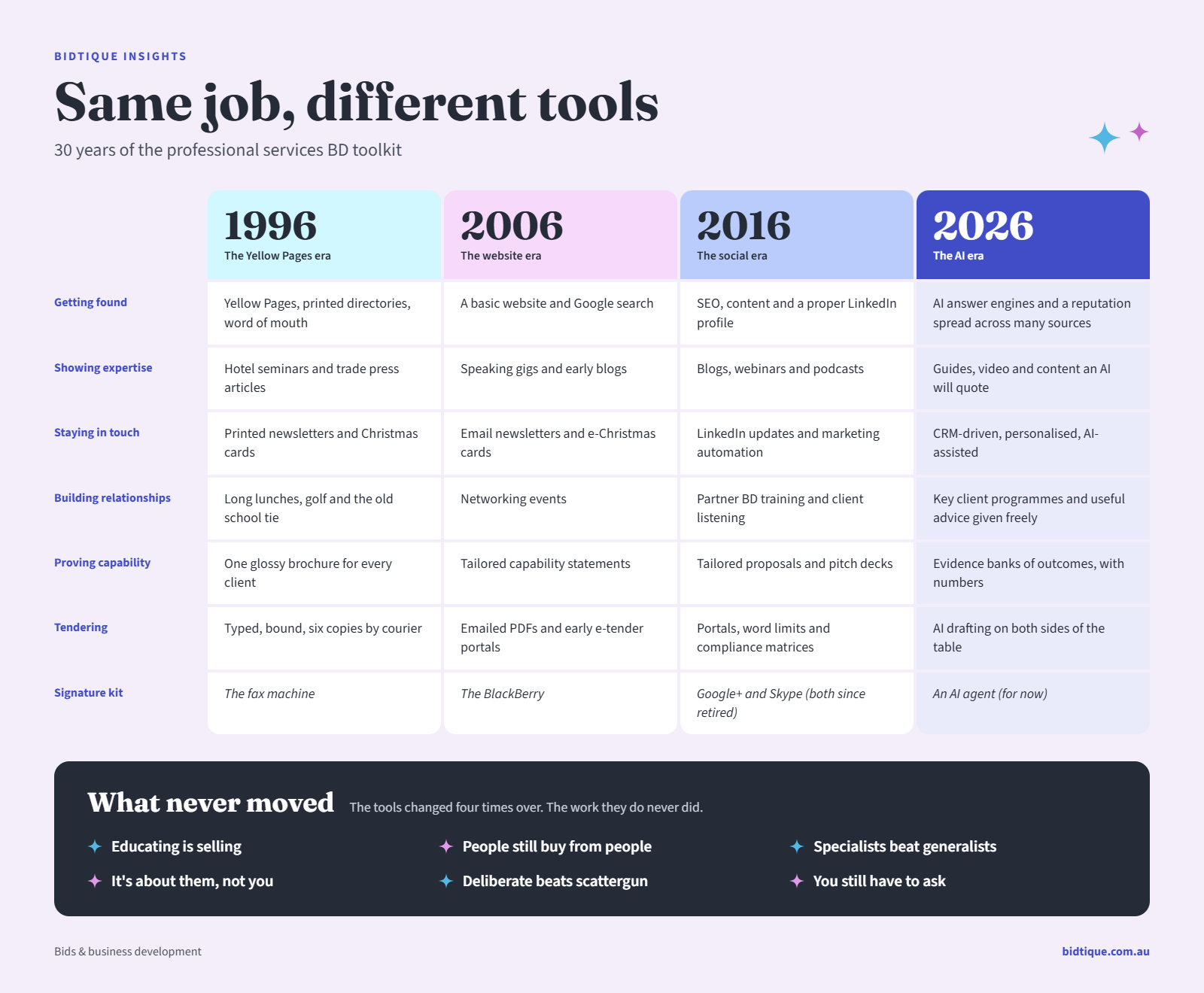
Same job, different tools: 30 years of BD for professional services firms.
1996: the Yellow Pages era
Firms were found through printed directories and word of mouth. Expertise meant a hotel seminar or an article in the trade press. Tenders were typed, bound, and sent by courier in six hard copies.
2006: the website era
A basic website and Google search arrived. Email newsletters and e-Christmas cards replaced the printed kind, and capability statements started to be tailored. Tenders went out as emailed PDFs or through early e-tender portals.
2016: the social era
SEO, content marketing, and a proper LinkedIn profile became essential. Blogs, webinars, and podcasts showed expertise. Tender portals brought word limits and compliance matrices.
2026: the AI era
Buyers find firms through AI answer engines, so reputation depends on clear, specific content spread across many sources. Evidence of outcomes matters more than ever, and AI is drafting on both sides of the tender table.
The graveyard
Every item on this list was, at some point, the thing your firm simply had to be on.
The fax. Once the fastest way to lodge a late tender clarification. Now a curiosity.
Yellow Pages. The original search engine, delivered to your door and doubling as a doorstop.
The BlackBerry. Taught a generation of partners to answer client emails in four words.
The CD-ROM capability statement. Expensive. Admired. Unopened.
LinkedIn endorsements. The 2016 replacement for the written reference. Your colleague endorsed you for 'Litigation' and 'Microsoft Excel' in the same click.
Google+. Launched in 2011, closed to consumers in 2019. Firms that built communities there learnt a useful lesson about building on rented land.
Skype. Carried a generation of client calls, then quietly retired in 2025.
Clubhouse. Briefly the future of thought leadership, for about six weeks in 2021.
The QR code. Declared dead around 2014, then revived by a pandemic. Some tools don't die; they wait.
What never moved
Strip away the tools and the same handful of principles sit underneath every decade.
Educating is selling
The 1996 seminar in a hotel function room, the 2006 article, the 2016 blog, and the 2026 guide an AI search tool quotes back to a buyer are the same act. You show prospective clients you understand their problem before they pay you to solve it.
An accounting firm does it with an end-of-financial-year briefing. An engineering firm does it with a plain-English note on new building standards. A law firm does it with a guide to legislation its clients are dreading.
Educating is selling! It was in 1996, and it matters more now: answer engines reward firms that have published clear, specific, expert content.
People still buy from people
The lunch became the coffee, and the coffee became the Teams call. The mechanics shrank. The principle held.
Evaluators are told to score what's on the page, and most genuinely try. But the firm that has already helped a client think through the problem writes a better page.
Specialists beat generalists
In 1996 plenty of firms tried to be everything to everyone. Most still quietly do.
Would you take your Merc to the panel beater who specialises in all makes and all models? Your clients apply the same logic to their auditor, their engineer, and their lawyer.
It's about them
Brochureware talked about the firm. Good bids talk about the client.
Instead of: "We are a leading full-service firm with more than 200 professionals across four offices."
Try: "Your council faces three or four planning appeals a year that turn on heritage evidence. Our team has run 14 of them since 2020."
The first could be anyone. The second could only be you.
Deliberate beats scattergun
Chasing every tender and attending every event to see what sticks was a strategy in 1996. It still isn't one. Hope is not a strategy! Planned pursuits, honest go/no-go decisions, and measuring what actually wins work have outlasted every platform on the list above.
You have to ask
Thirty years ago, many professionals considered asking for work faintly vulgar. That attitude has mostly (though not entirely) died out. Clients appoint the firm that shows it wants the job.
The 2026 trap
AI is the most powerful addition to the kit in three decades. It is also the latest version of an old mistake: confusing the tool with the strategy.
A Google+ page was never a strategy. Neither was a blog with no point of view. An AI-drafted tender response with no win themes, no evidence, and no insight into what worries this particular client isn't one either.
AI can produce a competent 20-page response in an afternoon. So can every competitor on the panel. What it can't supply is the relationship, the judgement about which bids to chase, or the specific proof that you've done this before and done it well.
Those were the things that won work in 1996. They're still the things that win it now.
Final thought
By 2036 the kit will have changed again, and something we're excited about today will be in the graveyard next to Google+.
Use the new tools. Just don't mistake them for the real job of business development.
Happy bidding!