
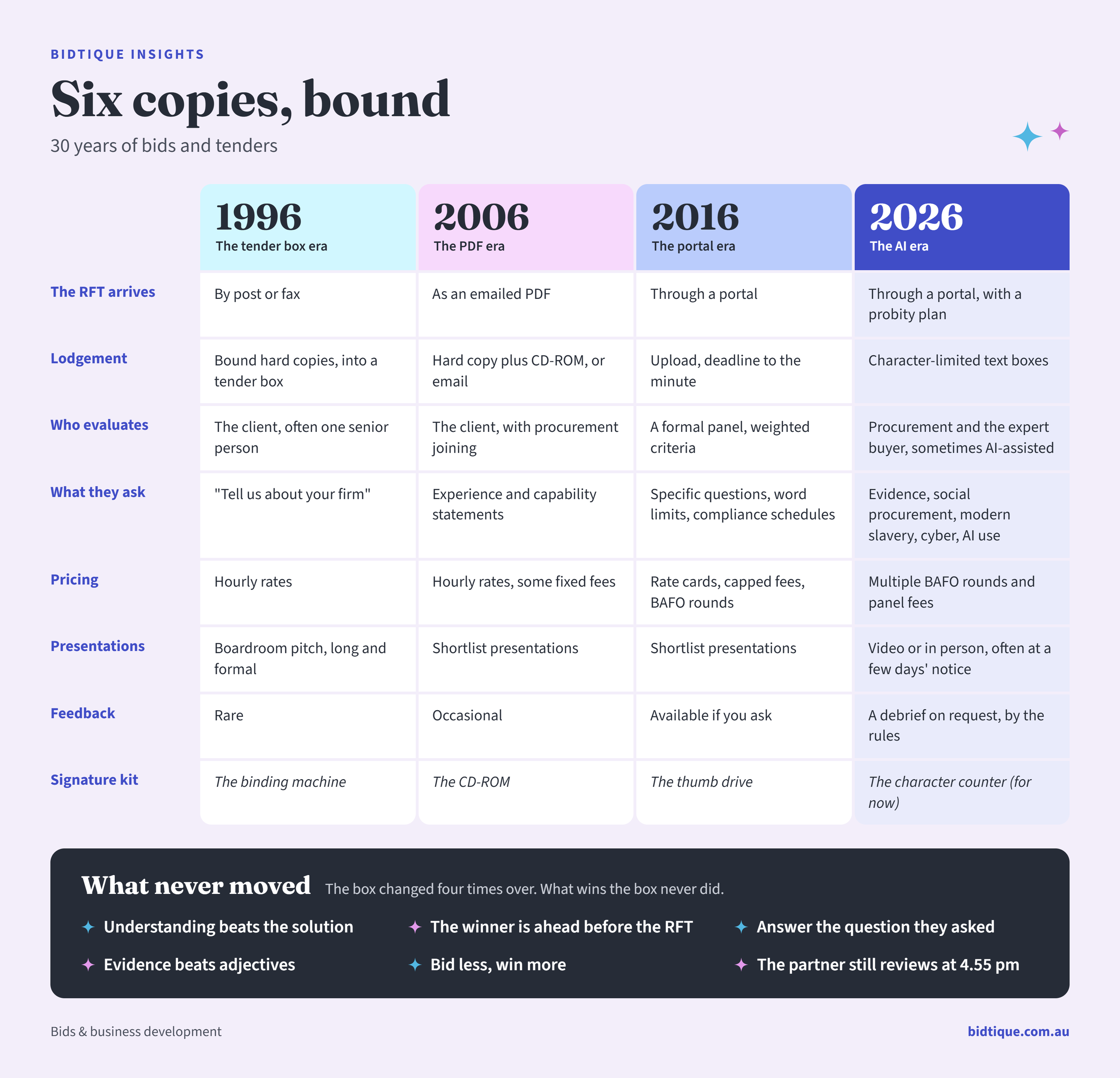
It's 1996. The RFT arrives by post. The response is typed, printed, tabbed, and bound: one original and five copies marked copy 1…. At 1.45 pm on the due date, a junior marketer is in a taxi on the way to the tender box, praying the traffic clears.
It's 2006. The RFT arrives as a PDF. Procurement has joined the evaluation panel. The response goes in on a CD-ROM, with a hard copy ‘for convenience’. Someone in the BD and marketing team has started saying ‘win themes’.
It's 2016. Everything goes through a portal. There are word limits, a compliance matrix, and a 40-page schedule of mandatory forms. The firm now has a bid manager and a content library, and nobody can find the latest version of anything.
It's 2026. The portal cuts you off at 2,000 characters, spaces included. There are sections on social procurement, modern slavery, and cyber security. The response may have been drafted with AI, and there's a fair chance the evaluator is using AI to read it.
Four tenders. Four completely different processes.
The same thing wins.
The box changed four times over. What wins the box never did.
A very short history of the tender
The professions came late to tendering. Everyone else had been at it for about 4,500 years.
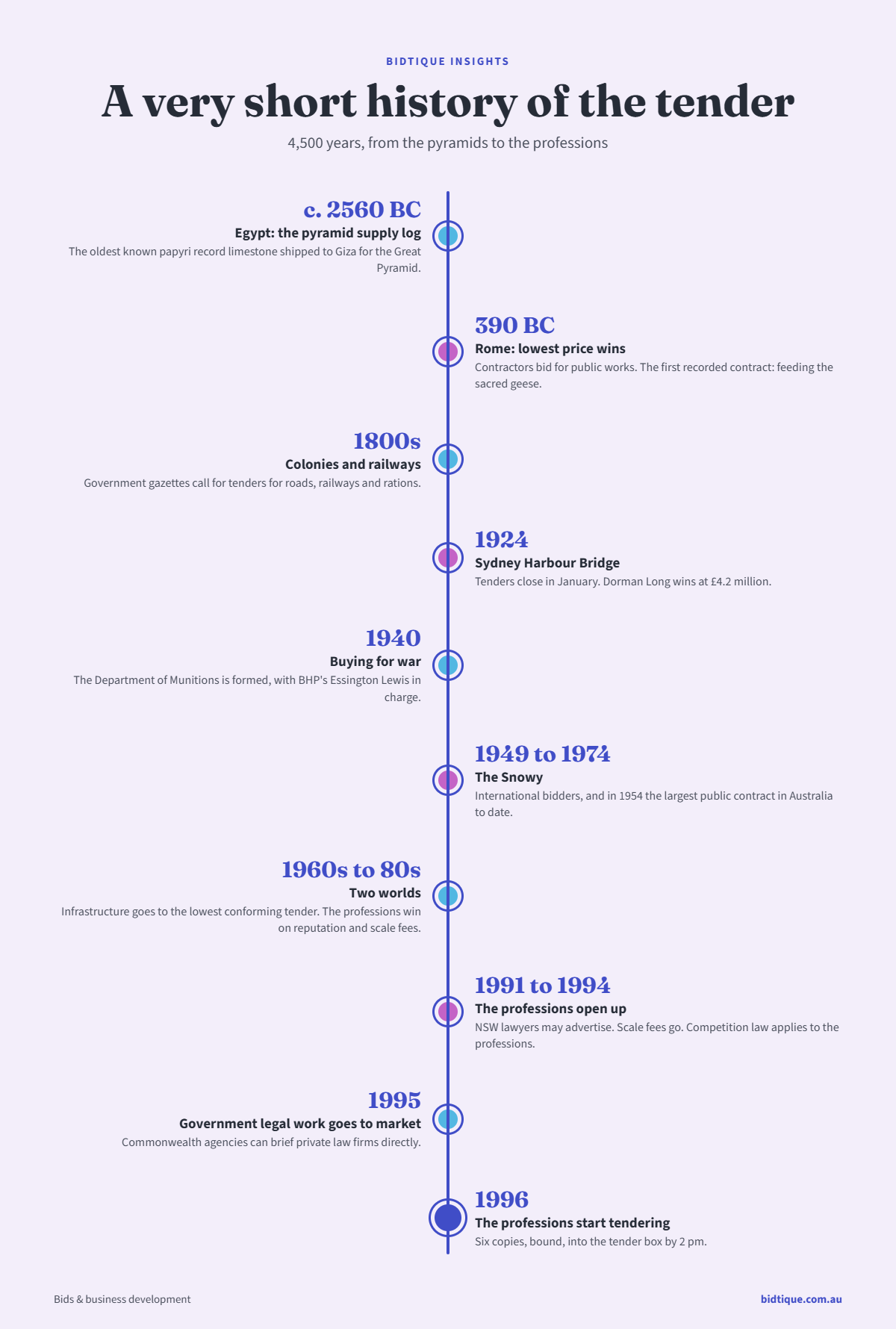
A short history of tendering
How the tender changed
The tender graveyard
Every item here was, at some point, an essential part of getting a bid out the door.
The tender box. A locked wooden box in a government foyer, and the source of more adrenaline than any sport.
The binding machine. Temperamental, loud, and always jammed at 11 pm.
Tab dividers. Colour-coded, hand-labelled, and in the wrong order in copy four.
The CD-ROM submission. Burned, labelled with a marker pen, and never inserted by anyone at the other end. Later superseded by the thumb drive, which is now banned by most information security policies, and fairly so.
The fax clarification. ‘Please confirm receipt by return fax’.
‘Section 1: Our history’. Three pages on the firm's founding in 1887, before a single word about the client.
The video submission. Predicted as the next big thing around 2020 (I predicted it myself). Buyers of professional services mostly didn't ask for it, and it found a home on LinkedIn instead.
What actually changed
Procurement arrived, and stayed
In 1996, most professional services work was appointed on relationship. Formal tenders for law firms were still rare.
By 2026, procurement sits on almost every large panel. The Commonwealth now buys all its external legal services through a single Legal Services Panel of 51 firms. Government remains the biggest buyer in the country: in 2024 - 25 the Australian Government awarded 86,926 contracts worth a record $104.9 billion.
The question got specific
Then (1996): ‘Please provide details of your firm's experience’.
Now (2026): ‘In no more than 2,000 characters, describe three matters from the past five years comparable in scale to Schedule 2, including outcomes, value, and the named team members who will deliver this work’.
The second can't be answered from a brochure. That's the point of it.
From good corporate citizen to ESG
A 1996 tender asked about your people. If it asked about anything else, it was whether you were a ‘good corporate citizen’, and a paragraph about the firm’s charity golf day would do.
The label has changed every decade or so since: triple bottom line, corporate social responsibility, then sustainability, social procurement then ESG, with diversity and inclusion (or DEI) alongside. The questions changed with it.
A 2026 tender asks what your work will do for the community, and expects evidence.
The Commonwealth's Indigenous Procurement Policy began in 2015. Victoria went further. In April 2018, it introduced Australia's first whole-of-government social procurement framework, asking suppliers to show how their contracts would create jobs for disadvantaged Victorians and people with disability, support gender equality, and buy from Aboriginal businesses and social enterprises.
It started with the big infrastructure projects. It didn't stay there. Social procurement questions have since spread through state agencies, other jurisdictions, and local councils, and they now turn up in professional services tenders worth a fraction of a rail project.
The expectations keep stacking up. The Modern Slavery Act 2018 took effect on 1 January 2019. Firms on the Commonwealth's legal panel must now meet the National Pro Bono Target, not merely try.
It's no longer enough to say you have a policy. You have to prove it, with certificates, statements, and numbers.
Winning started to cost more
Panels increasingly charge suppliers for the privilege of being on them. On New Zealand's all-of-government legal services contract, the administration fee is 1.5% of everything a firm invoices. Insurance demands have grown out of all proportion to the jobs: I once saw a university require
$25 million of professional indemnity cover for a job worth less than $40,000.
Timelines have compressed too. 3 weeks or 15 business days rather than the customary 4 weeks and 20 business days seems increasingly to be the new normal.
What never moved
Understanding beats the solution
In the mid-1970s, a survey of buyers found that about 40% of appointments came down to having the best solution. When rogenSi asked more than 3,000 bidders the same question in 2008, ‘best solution’ had fallen to 29%, and ‘understanding the client's business’ had jumped from 20% to 32%.
Their explanation still holds: the best solution had become a given. ‘You either have it or you don't’.
The winner is often ahead before the RFT arrives
The same 2008 report described an audit bid lost to a firm that had been meeting the prospect monthly for two years before the tender was released. The winner, it said, ‘had been 25 points ahead before we walked out on to the field.’
Probity rules mean you can't lobby a buyer during a live tender. You can still do good work, give useful advice, and understand their business long before the RFT lands on anyone's desk.
Answer the question they asked
Compliance doesn't win a tender, but non-compliance loses it. In 1996 that meant answering in the right order. In 2026 it means answering inside the character limit. The discipline is identical.
Evidence beats adjectives
‘Leading’, ‘trusted’, and ‘client-focused’ have never won a tender. Matters, outcomes, numbers, and references who pick up the phone always have.
Bid less, win more
In 2008, 16% of bidders said the cost of pitching had doubled or more in a decade. It hasn't come down since. Choosing which tenders not to bid for is still the fastest way to improve your win rate. Hope is not a strategy!
The process is never followed
Also in 2008: 86% of firms said they had a formal bid process, but only 7% said it was always followed.
I have no 2026 figure. I have hundreds of bids' worth of anecdotal evidence that the partner still reviews at 4.55 pm on the due date. Sigh.
The 2026 trap
In 2008, the best solution became a given. In 2026, the well-written response has become a given too.
AI can produce a fluent, compliant answer in an afternoon. So can every competitor on the panel. When everyone's writing is competent, competent writing stops scoring.
The marks go to what AI can't supply: understanding of this client's problem, specific evidence that you've solved it before, and judgement about what to leave out. That's the same list that won in 1996, minus the binding machine.
Final thought
The tender box is gone, the binding machine is in landfill, and the CD-ROMs are coasters. By 2036, something we can't do without today will be in the graveyard next to them.
Box, portal, or AI, the job is the same. Understand the buyer, answer the question, and prove it.
Happy bidding!
Sources
National Archives of Australia: Snowy Mountains Hydro-Electric Scheme
Newcastle Law Review: Justifying the NSW legal profession 1976 to 1997
Department of Finance: Statistics on Australian Government procurement contracts
Australian Pro Bono Centre: Commonwealth Legal Services Panel
University of Melbourne Pursuit: How social procurement can revive Victoria's economy
Buying for Victoria: Victoria's Social Procurement Framework
Neil Flett, ‘Perfect Pitch: the changing worlds of bids and tenders 1978 to 2008’, rogenSi white paper, 2008